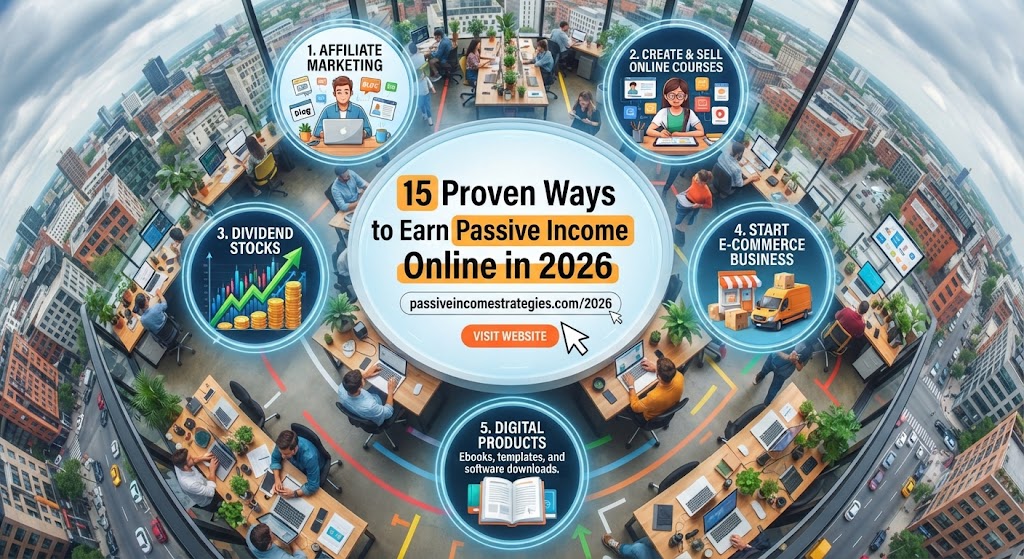
15 Proven Ways to Earn Passive Income Online
15 Proven Ways to Earn Passive Income Online: The Ultimate Guide to Financial Freedom
The dream of “earning money while you sleep” is no longer a privilege reserved for the elite or the “lucky” few who stumbled into early crypto investments. In the modern digital economy, passive income is a tangible, scalable reality for anyone with a laptop, an internet connection, and the discipline to build an asset.
However, let’s clear the air: “Passive” does not mean “zero effort.” True passive income is the result of front-loading your work. You build a system, create a product, or invest capital today so that it generates revenue tomorrow with minimal ongoing maintenance. It is about decoupling your time from your income.
1. High-Ticket Affiliate Marketing
Affiliate marketing is the process of earning a commission by promoting other people’s (or companies’) products. While many beginners start with low-ticket items (like $10 books on Amazon), the real wealth is found in high-ticket affiliate marketing.
How It Works:
You sign up for an affiliate program, receive a unique tracking link, and promote that link through a blog, social media, or email list. When someone clicks and makes a purchase, you get a cut.
Why It’s Powerful:
High-ticket items—such as enterprise software, luxury travel packages, or premium online coaching—can offer commissions ranging from $500 to $5,000 per sale. You need far less traffic to reach a full-time income compared to selling low-margin commodities.
Pro Tip: Focus on “recurring commission” programs. Many SaaS (Software as a Service) companies pay you every month the customer remains a subscriber, creating a compounding monthly income.
2. Create and Sell Online Courses
The global e-learning market is projected to reach hundreds of billions of dollars in the coming years. People are moving away from traditional degrees and toward specific, skill-based results.
How It Works:
Identify a problem you know how to solve (e.g., Python coding, vegan meal prepping, or digital marketing). Record a series of video modules, create worksheets, and host them on platforms like Teachable, Kajabi, or Udemy.
Why It’s Powerful:
Once the course is filmed and the sales funnel is set up, your “cost of goods sold” is effectively zero. Whether you sell 10 copies or 10,000, your workload remains largely the same.
Pro Tip: Use the “Beta Launch” method. Sell the idea of the course before you build it to ensure there is market demand, then build it live with your first group of students.
3. Launch a Niche Authority Blog
Blogging is often dismissed as “old school,” but it remains one of the most reliable ways to build a long-term passive income asset. The key is to move away from “personal journaling” and toward “authority building.”
How It Works:
You create content that answers specific questions or solves problems within a niche (e.g., “Best backpacking gear for the Rockies” or “How to automate small business accounting”). You monetize through display ads (Mediavine, AdThrive), affiliate links, and sponsored posts.
Why It’s Powerful:
Search Engine Optimization (SEO) allows your articles to rank on Google. This means people find your site while you are sleeping, eating, or traveling. A well-optimized blog can generate thousands of dollars monthly for years after the articles are written.
Pro Tip: Don’t go broad. Instead of “Fitness,” choose “Strength training for men over 50.” Specificity wins in the modern SEO landscape.
4. Print on Demand (POD)
Print on Demand is the “hands-off” version of e-commerce. You design graphics for t-shirts, mugs, posters, or hoodies, but you never touch the physical inventory.
How It Works:
You upload your designs to platforms like Printful, Printify, or Redbubble. You then list these products on your own Shopify store or marketplaces like Etsy. When a customer buys, the POD provider prints the item and ships it directly to the customer.
Why It’s Powerful:
There is no upfront cost for inventory. You don’t have a garage full of unsold shirts. Your only job is the creative design and marketing.
Pro Tip: Leverage AI design tools like Midjourney to create high-quality, unique graphics that stand out in crowded marketplaces.
5. Build a SaaS (Software as a Service) Product
Software is the ultimate leverage. If you can identify a repetitive task that people hate doing and automate it with software, you have a goldmine.
How It Works:
You don’t even need to be a coder. You can use “no-code” builders like Bubble or Webflow, or hire developers on Upwork to build a “Micro-SaaS”—a small software tool that solves one specific problem.
Why It’s Powerful:
SaaS models are built on monthly subscriptions. This creates the most predictable form of passive income. Once a user integrates your tool into their daily workflow, they are unlikely to cancel.
Pro Tip: Look for “app gaps” in ecosystems like Shopify, Slack, or Salesforce. Building a plugin for an existing platform is often easier than building a standalone software.
6. YouTube Automation
You don’t need to be a “celebrity” or even show your face to earn money on YouTube. Many of the most profitable channels are “faceless” or “automated” channels.
How It Works:
You choose a niche (e.g., Luxury Travel, Financial News, or Horror Stories), hire a scriptwriter, a voice-over artist, and a video editor. You act as the producer, overseeing the upload and SEO strategy.
Why It’s Powerful:
Once a video is uploaded, it becomes a digital asset that earns money through YouTube’s AdSense program and sponsorships for years. As the channel grows, the library of content compounds.
Pro Tip: Focus on high CPM (Cost Per Mille) niches. Advertisers pay more to show ads on finance or tech videos than they do on prank videos.
7. Sell Digital Products (Templates & E-books)
Digital products are the “low-hanging fruit” of passive income. They are easier to create than courses and have no shipping costs.
How It Works:
Create Notion templates, Excel budget trackers, Canva social media templates, or specialized E-books. Sell them on your own site or marketplaces like Gumroad or Etsy.
Why It’s Powerful:
Digital products solve immediate problems. If a business owner can spend $20 to save 5 hours of work using your template, they will buy it instantly.
Pro Tip: Focus on “B2B” (Business to Business) templates. Businesses have higher budgets and a greater need for efficiency than individual consumers.
8. Dividend Growth Investing
This is the most “passive” of all methods, as it requires only capital and a brokerage account.
How It Works:
You invest in stocks of companies that pay out a portion of their earnings to shareholders—these are called dividends. “Dividend Aristocrats” are companies that have increased their dividends every year for at least 25 years.
Why It’s Powerful:
By reinvesting your dividends (using a DRIP—Dividend Reinvestment Plan), you benefit from compound interest. Over time, your portfolio grows large enough that the dividend payouts can cover your living expenses.
Pro Tip: Focus on total return, not just high yield. A 10% dividend yield is often a “yield trap” if the company’s stock price is crashing.
9. Real Estate Crowdfunding
Traditionally, real estate required huge down payments and the “three Ts”: Tenants, Toilets, and Trash. Digital platforms have changed that.
How It Works:
Platforms like Fundrise or RealtyMogul allow you to pool your money with other investors to buy shares in large commercial or residential projects. You earn a share of the rental income and the appreciation.
Why It’s Powerful:
You get the benefits of real estate (cash flow and tax advantages) without the headaches of being a landlord. You can start with as little as $500 in some cases.
Pro Tip: Diversify your holdings across different geographic regions to protect yourself from local real estate market downturns.
10. Peer-to-Peer (P2P) Lending
Become the bank. P2P lending allows you to lend your money directly to individuals or small business owners.
How It Works:
Using platforms like Prosper or LendingClub, you browse “notes” or loan requests. You can contribute a small amount (e.g., $25) to many different loans to spread your risk. As the borrowers pay back their loans with interest, you get a cut.
Why It’s Powerful:
The interest rates are often significantly higher than what you would get in a traditional savings account.
Pro Tip: Use the “auto-invest” features offered by these platforms to automatically reinvest your returns, ensuring your money is always working for you.
11. Create a Paid Newsletter
With the rise of “The Creator Economy,” people are increasingly willing to pay for curated, high-quality information delivered directly to their inbox.
How It Works:
Use platforms like Substack or Beehiiv. You offer a free version of your newsletter to build an audience and a “Pro” version with deep-dives, insider tips, or exclusive data for a monthly fee (e.g., $10/month).
Why It’s Powerful:
You own the relationship with your audience. Unlike social media, where algorithms can hide your content, your email goes straight to the subscriber.
Pro Tip: Don’t just report news. Provide analysis. Tell your readers what the news means for their wallet or their career.
12. Stock Photography and Videography
If you have a talent for visual arts, your hard drive full of photos and clips could be an untapped goldmine.
How It Works:
Upload high-quality photos or B-roll video footage to sites like Shutterstock, Adobe Stock, or Getty Images. Every time a creator or company licenses your content, you receive a royalty.
Why It’s Powerful:
Businesses are constantly in need of “authentic” looking stock footage for social media ads and blog posts. Content created years ago can continue to sell indefinitely.
Pro Tip: Look for “trending” searches on these platforms. Currently, there is high demand for diverse representation and “work from home” lifestyle imagery.
13. Rent Out “Digital Real Estate” (Lead Generation)
This is a hybrid of SEO and service-based business, but it becomes highly passive once established.
How It Works:
You build a website targeting a specific local service in a specific city (e.g., “Tree Trimming in Orlando”). You rank that site on the first page of Google. When local customers call the number on the site, the lead is automatically forwarded to a local contractor who pays you for the lead.
Why It’s Powerful:
Once the site is ranking, it requires very little maintenance. The local business owner is happy because they get customers, and you are happy because you get a “rent” check every month.
Pro Tip: Focus on “emergency” services like plumbing, towing, or roofing. These services have a high “intent to buy,” making the leads more valuable.
14. High-Yield Savings Accounts (HYSA) and CDs
While not as “sexy” as SaaS or YouTube, this is the safest way to generate passive income.
How It Works:
In a high-interest rate environment, traditional banks and online fintech companies offer HYSAs or Certificates of Deposit (CDs) that pay significantly higher interest than a standard checking account.
Why It’s Powerful:
It is FDIC insured. Your principal is safe. It is the perfect place to park your “emergency fund” or the profits from your other passive income streams so they can continue to grow.
Pro Tip: Look for “neobanks” like SoFi or Wealthfront, which often offer higher rates than the “Big Four” traditional banks.
15. License Your Music or Sound Effects
Just as photographers sell photos, musicians can sell their sounds.
How It Works:
If you can produce “lo-fi” beats, cinematic transitions, or even simple sound effects (like a “whoosh” or a “click”), you can upload them to AudioJungle, Epidemic Sound, or Artlist.
Why It’s Powerful:
The explosion of content creation (TikTok, YouTube, Podcasts) has created an insatiable demand for royalty-free music. One catchy background track can be licensed thousands of times.
Pro Tip: Study the “vibe” of popular YouTube creators. If you can create music that fits the “aesthetic” of top vloggers, your tracks will be in high demand.
The Strategic Path: How to Actually Succeed
Many people fail at passive income because they try to do all 15 at once. Success requires a focused strategy.
Phase 1: The Active Build
Choose one method that aligns with your skills. If you like writing, start a blog. If you like numbers, look at dividend stocks. If you like tech, look at SaaS. Spend 6–12 months focusing exclusively on this.
Phase 2: Systematize and Delegate
Once your first stream is making $500–$1,000 a month, look for ways to step back. Can you hire an editor? Can you automate your social media posts? Use your profits to buy back your time.
Phase 3: The Multiplier Effect
Now that Stream #1 is running with minimal input from you, take the excess cash flow and invest it into Stream #2. For example, use your blog profits to buy dividend stocks or real estate crowdfunding shares. This is how “wealth snowballs” are created.
Common Pitfalls to Avoid
- The “Shiny Object” Syndrome: Jumping from one method to another the moment things get difficult. Every one of these 15 methods works, but none of them work overnight.
- Neglecting Quality: Because it’s “passive,” some people think they can put out low-quality content or products. In a digital world, quality is the only thing that survives the algorithm.
- Forgetting Taxes: Passive income is still taxable income. Set aside a percentage of every dollar you earn for the IRS (or your local equivalent).
Final Thoughts: The Cost of Freedom
The “cost” of passive income is almost always paid in time or capital.
If you have money but no time, investing (Dividends, Real Estate, P2P) is your path. If you have time but no money, creating (Blogging, YouTube, Digital Products) is your path.
The best time to start building your passive income portfolio was ten years ago. The second best time is today. Choose one path, commit to the “front-loaded” work, and start building the life where your mailbox brings you more money than your boss does.