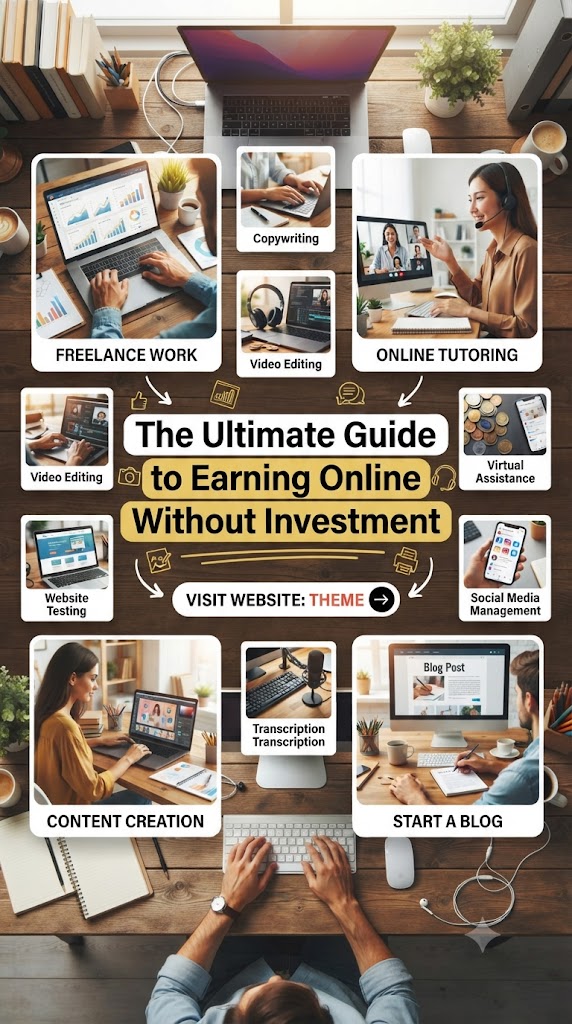

How to Make $1,000 a Month from Home
The Ultimate Blueprint: How to Earn a Consistent $1,000 a Month from Home
In an era where the traditional 9-to-5 is no longer the only path to financial stability, the quest for a “side hustle” has evolved from a luxury into a necessity for many. Whether you are looking to crush debt, save for a dream vacation, or simply breathe easier when the monthly bills arrive, earning an extra $1,000 a month from home is a life-changing milestone.
The beauty of the $1,000 mark is its feasibility. It is high enough to make a significant impact on your lifestyle but low enough that it doesn’t require a PhD or $100,000 in startup capital. It requires a blend of strategy, consistency, and the willingness to learn new skills.
This guide explores the most effective, battle-tested methods to generate $1,000 a month from the comfort of your living room. We will break down the “how,” the “where,” and the “math” behind each method so you can choose the path that aligns with your skills and schedule.
Why $1,000 is the Perfect Milestone
Before diving into the “how,” let’s look at the “why.” Earning $1,000 a month translates to $12,000 a year. For most households, this covers:
- An average monthly mortgage or rent payment.
- The total annual cost of groceries for a small family.
- Maxing out a Roth IRA for retirement.
- A complete elimination of high-interest credit card debt within a year.
By focusing on $1,000, you move away from the “get rich quick” fantasies and toward a sustainable, scalable business model.
Strategy 1: The Freelance Service Model (The Fastest Path)
Freelancing is the most direct way to hit $1,000 because you are trading your skills for immediate payment. You don’t have to wait for an algorithm to pick up your video or for a product to sell; you simply complete a task and get paid.
1. High-Value Freelance Writing
Content is the currency of the internet. Businesses, blogs, and marketing agencies are in constant need of articles, white papers, and newsletters.
- How to hit $1,000: If you charge $0.10 per word (a standard starting rate for quality writers), you need to write 10,000 words a month. That is roughly four 2,500-word deep-dive articles or ten 1,000-word blog posts.
- Where to find work: ProBlogger Job Board, Contena, and cold-pitching local businesses.
- The Pro Tip: Niche down. Writers who specialize in “FinTech,” “Saas,” or “Medical Technology” can charge $0.25 to $0.50 per word, reaching the $1,000 goal with just two or three articles.
2. Virtual Assistance (VA)
A Virtual Assistant is the backbone of a busy entrepreneur’s life. Tasks include email management, scheduling, basic data entry, and customer support.
- How to hit $1,000: At a rate of $25 per hour, you only need to work 40 hours a month—just 10 hours a week.
- Where to find work: Belay, Fancy Hands, or by networking in Facebook groups for small business owners.
- The Pro Tip: Offer specialized VA services like “Pinterest Management” or “Podcast Show Note Writing.” Specialization allows you to charge premium package rates rather than hourly fees.
3. Graphic Design and Social Media Assets
If you have an eye for aesthetics and know your way around Canva or Adobe Creative Suite, businesses will pay you to create their visual identity.
- How to hit $1,000: Create a package of 20 Instagram tiles and 5 Reels for $500. Secure just two clients a month.
- Where to find work: 99Designs, Dribbble, or Upwork.
- The Pro Tip: Focus on “Templates.” Create a set of templates for a specific industry (e.g., Real Estate agents) and sell them repeatedly on Etsy or your own site while offering custom edits for a fee.
Strategy 2: High-Value Tutoring and Coaching
Knowledge is one of the most profitable assets you own. If you excel at a specific subject or have a professional skill, someone is willing to pay to learn it from you.
1. Academic Tutoring
With the rise of remote learning, online tutoring has exploded. Subjects like SAT/ACT prep, Calculus, and Physics command the highest rates.
- How to hit $1,000: Tutors for specialized subjects often charge $40–$60 per hour. At $50/hour, you only need 20 hours of tutoring a month (5 hours a week).
- Where to find work: Wyzant, TutorMe, or Skooli.
- The Pro Tip: Market yourself to local parents via Nextdoor or Facebook. By cutting out the “middleman” platform, you can keep 100% of your hourly rate.
2. Teaching English (ESL)
While the landscape has changed recently, platforms still exist for teaching English to students in Europe, South America, and Asia.
- How to hit $1,000: Most platforms pay $15–$22 per hour. You will need to commit to approximately 12–15 hours a week to hit the target.
- Where to find work: Preply, Cambly, or Italki.
3. Skill Coaching
Are you great at chess? Do you know how to build furniture? Are you a master of Excel?
- How to hit $1,000: Create a 4-week “bootcamp” or a series of 1-on-1 coaching sessions. If you charge $250 for a transformation package, you only need 4 clients a month.
Strategy 3: The Reselling Revolution (Flipping)
Reselling is the art of “arbitrage”—buying something low and selling it high. It is one of the oldest business models in the world and works exceptionally well from home.
1. Thrift Store and Garage Sale Flipping
This involves hunting for undervalued items at local sales and listing them on global marketplaces.
- How to hit $1,000: This is about “The Spread.” If you average a $20 profit per item after fees and shipping, you need to sell 50 items a month (roughly 12 items a week).
- What to look for: Vintage clothing (90s era), discontinued electronics, high-end kitchen appliances (Le Creuset, Vitamix), and board games.
- Where to sell: eBay, Poshmark, and Depop.
2. Retail Arbitrage
Buying discounted items from big-box stores like Walmart, Target, or Ross and selling them for a profit on Amazon.
- How to hit $1,000: Use the Amazon Seller App to scan barcodes in the clearance aisle. If you find a toy for $5 that sells for $20 on Amazon, you’ve found a winner.
- The Pro Tip: Focus on “consumables” (beauty products, grocery items) that people buy repeatedly, ensuring a steady stream of sales.
3. Facebook Marketplace Flipping (Large Items)
This requires a bit of space (like a garage) but has huge margins. People often give away or sell furniture for cheap because they are moving.
- How to hit $1,000: Buy a weathered wooden dresser for $40, sand it, paint it, add new hardware, and sell it for $250. Do this once a week, and you’ve surpassed your $1,000 goal with just four sales.
Strategy 4: Micro-Gigs and Testing (The Low-Barrier Entry)
If you don’t have a specific skill to sell yet, you can still reach $1,000 by stacking “micro-gigs.” These require no upfront investment and can be started today.
1. User Testing
Companies want to know if their websites and apps are easy to use. They will pay you to record your screen and voice while you navigate their site.
- How to hit $1,000: Most tests pay $10 for 20 minutes. “Live interviews” pay $30–$120 for an hour. If you do 2 live interviews a week and 5 standard tests, you can pull in $400–$500 a month.
- Where to find work: UserTesting, TryMyUI, and Userlytics.
- The Pro Tip: Keep the browser tab open and respond to invitations immediately; these gigs go fast!
2. Specialized Data Entry and Transcription
While generic data entry pays poorly, specialized transcription (legal or medical) pays significantly better.
- How to hit $1,000: At a rate of $15–$20 per hour of work, this is a volume game. You will need to dedicate about 15–20 hours a week.
- Where to find work: Rev, TranscribeMe, or Scribie.
Strategy 5: Content Creation and Passive Income Streams
This strategy takes the longest to “warm up,” but it is the most scalable. Once the foundation is built, the income becomes relatively passive.
1. Print on Demand (POD)
You design a t-shirt, mug, or poster and upload the design to a site. When someone buys it, the site prints and ships it, and you get a royalty.
- How to hit $1,000: With a royalty of $5 per shirt, you need 200 sales a month. This sounds like a lot, but if you have 500 designs across multiple platforms, it’s only a few sales per design.
- Where to start: Redbubble, Amazon Merch on Demand, and Printful (integrated with Etsy).
2. Affiliate Marketing via Niche Blogging
Create a blog or a social media page focused on a very specific topic (e.g., “Best Gear for Indoor Gardening”). Recommend products using affiliate links.
- How to hit $1,000: If you earn a 5% commission on a $100 product, you need 200 sales. With 20,000 monthly visitors, a 1% conversion rate gets you there.
- The Pro Tip: Focus on high-ticket items. Selling one $2,000 treadmill earns you more than selling fifty $10 books.
3. YouTube Faceless Channels
You don’t need to be a celebrity. Channels that focus on “Top 10” lists, financial news, or meditation music can earn significant ad revenue.
- How to hit $1,000: Once monetized, an average channel might earn $3–$10 per 1,000 views. To hit $1,000, you need roughly 150,000 to 300,000 views a month.
- The Pro Tip: Use AI tools like Midjourney for visuals and ElevenLabs for voiceovers to speed up production.
The Math of $1,000: Breaking Down the Numbers
To avoid feeling overwhelmed, you must view the $1,000 goal through the lens of simple mathematics. There are three primary ways to reach the number:
The Specialist (Low Volume, High Price)
- Approach: Freelance Web Design or High-End Consulting.
- The Math: 1 project at $1,000 = $1,000.
- Time Commitment: Variable (often 10–20 hours of focused work).
The Worker Bee (Medium Volume, Medium Price)
- Approach: Virtual Assistant or Tutoring.
- The Math: 40 hours at $25/hour = $1,000.
- Time Commitment: 10 hours per week.
The Hustler (High Volume, Low Price)
- Approach: Micro-gigs, Surveys, and Small Flips.
- The Math: 100 tasks/sales at $10 profit each = $1,000.
- Time Commitment: 20–30 hours per week.
Essential Tools for the Work-From-Home Professional
To succeed, you need to treat your home office like a real business. Here are the essential tools to manage your $1,000/month journey:
- Toggl Track: A free time-tracking tool. If you don’t track your time, you won’t know your true hourly rate.
- Canva: For creating professional-looking invoices, social media posts, and pitch decks.
- Grammarly: Essential for any written communication with clients.
- Loom: Great for recording quick videos to explain things to clients or record user tests.
- Trello/Asana: Free project management tools to keep track of deadlines and “to-do” lists.
Overcoming the Psychological Hurdles of Remote Work
The biggest obstacle to earning $1,000 a month isn’t a lack of opportunity; it’s the environment. Working from home is a minefield of distractions.
The “Procrastination” Trap
When you are your own boss, it’s easy to say, “I’ll do it after I watch this episode.”
- The Fix: Use the Pomodoro Technique. Work for 25 minutes, then take a 5-minute break. This makes daunting tasks feel manageable.
The “Shiny Object” Syndrome
Many people fail because they try to do five things at once. They start a blog, then switch to dropshipping, then try to become a VA.
- The Fix: The Rule of One. Pick ONE method, ONE platform, and ONE target audience. Stick with it until you earn your first $100. Only then should you consider diversifying.
The Isolation Factor
Working from home can be lonely, leading to a decrease in motivation.
- The Fix: Join “Co-working” Zoom rooms or local Facebook groups for freelancers. Having a community of people doing the same thing keeps you accountable.
How to Scale Beyond $1,000
Once you hit the $1,000 mark consistently, you have a proven “proof of concept.” Now, you have two choices: maintain or scale.
- Increase Your Rates: If you are a freelancer and your schedule is full, it’s time to raise your prices by 20%. Some clients might leave, but you’ll earn more for less work.
- Outsource the Busy Work: If you are flipping items on eBay, hire someone to do the packaging and shipping for you so you can focus on sourcing more inventory.
- Productize Your Service: If you are a VA, create a “Quickstart Guide for New Entrepreneurs” and sell it as a digital download. This adds a passive income layer to your active income.
Final Thoughts: Your Action Plan for Month One
To hit $1,000 a month, you cannot just “try.” You must execute. Here is your 4-week roadmap:
- Week 1: The Audit. Identify your top three skills. Research which platforms (Upwork, eBay, Wyzant) are the best fit. Create your profiles.
- Week 2: The Outreach. Send 10 pitches a day or list 5 items for sale every day. This is the “momentum” phase.
- Week 3: The Refinement. Analyze what is working. Are people clicking your profile but not hiring? Fix your bio. Are your items not selling? Take better photos.
- Week 4: The Push. By now, you should have made your first $50–$100. Double down on the activities that generated that money.
Earning $1,000 a month from home is not a myth. It is a mathematical certainty for anyone who provides value to the marketplace and remains consistent. The internet has leveled the playing field—now it’s your turn to step onto the pitch.