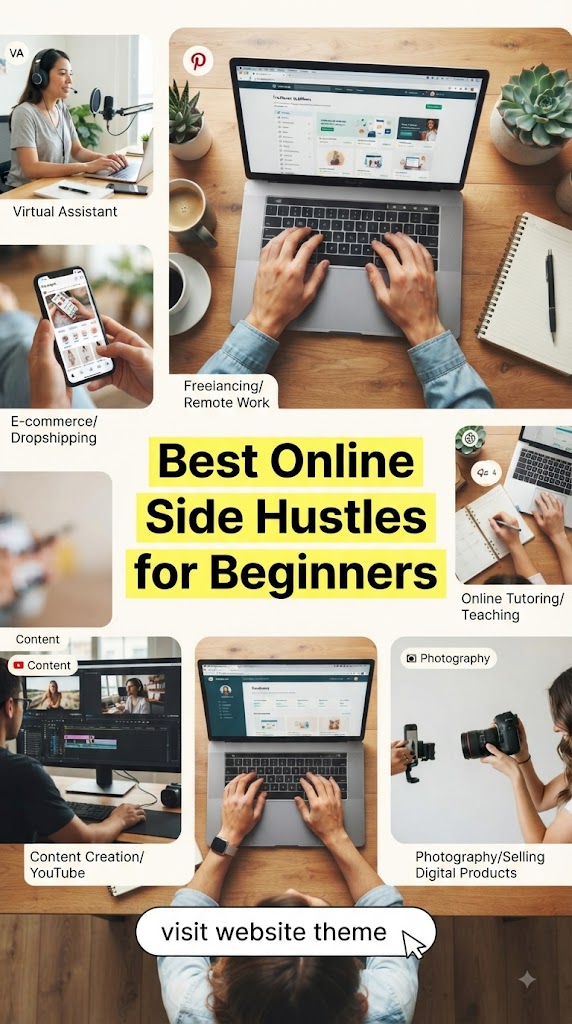
Best Online Side Hustles for Beginners
The Ultimate Guide to the Best Online Side Hustles for Beginners: Start Earning Today
The traditional 9-to-5 career path is undergoing a seismic shift. In an era defined by inflation, economic uncertainty, and the rise of the “gig economy,” the concept of having a single source of income is becoming increasingly risky. Today, the most successful individuals aren’t just working harder; they are working smarter by leveraging the power of the internet to build multiple streams of income.
Whether you want to pay off student loans, save for a dream vacation, or eventually quit your day job to travel the world, the digital landscape offers a playground of opportunities. But with so many options—from dropshipping to data entry—where do you actually begin?
This comprehensive guide breaks down the best online side hustles for beginners, categorized by skill level, time commitment, and income potential. We’ll skip the “get rich quick” scams and focus on legitimate, scalable business models that you can start from your living room today.
1. The Power of Freelance Writing: Turning Words into Wealth
Freelance writing is perhaps the most accessible side hustle for beginners. If you can write a coherent email, you can write a blog post. If you can write a blog post, you can write white papers, case studies, and sales copy that commands premium rates.
Why It’s Great for Beginners
Freelance writing has a low barrier to entry. You don’t need a fancy degree or expensive software—just a laptop, an internet connection, and the ability to meet deadlines.
How to Get Started
- Identify Your Niche: Generalists make pennies; specialists make dollars. Choose a niche like Finance, SaaS (Software as a Service), Health and Wellness, or Real Estate.
- Build a Portfolio: You don’t need clients to have a portfolio. Create a Medium account or a personal blog and write three high-quality pieces in your chosen niche.
- Pitching: Use platforms like Upwork and Fiverr to find initial clients, but quickly move toward “cold pitching” businesses directly via LinkedIn or email to secure higher rates.
Income Potential
- Beginner: $0.05 – $0.10 per word ($50 – $100 per article).
- Expert: $0.50 – $1.00+ per word ($500 – $1,500+ per article).
2. Virtual Assistant (VA): The Backbone of Digital Businesses
As online entrepreneurs and small business owners grow, they inevitably run out of time. They need someone to manage their emails, schedule social media posts, and handle customer inquiries. This is where the Virtual Assistant comes in.
What Does a VA Do?
- Email Management: Clearing out the “In-Box Zero” nightmare.
- Calendar Scheduling: Coordinating meetings and appointments.
- Data Entry: Organizing spreadsheets and CRM systems.
- Basic Content Management: Uploading blog posts to WordPress.
How to Scale
Once you master the basics, you can specialize as a Technical VA (managing complex software like Keap or Salesforce) or an Executive VA, where you take on higher-level project management roles. These specializations allow you to double or triple your hourly rate.
3. User Testing: Get Paid to Share Your Opinion
If you’re looking for something that requires zero specialized skills and can be done in your spare time, user testing is the answer. Companies like Google, Airbnb, and Amazon need to know if their websites and apps are intuitive.
Top Platforms
- UserTesting: The industry leader. You get paid roughly $10 for every 20-minute video review you complete.
- Intellizoom: Offers a variety of tasks, from simple surveys to video-based UI (User Interface) testing.
- TryMyUI: Similar to UserTesting, focusing on the “think out loud” method of website navigation.
The Reality Check
User testing won’t make you a millionaire. It is a “linear” hustle—you only get paid for the time you put in. However, it’s an excellent way to earn an extra $200–$500 a month with very little effort.
4. Selling Digital Products: The Path to Passive Income
Passive income is the holy grail of side hustles. Selling digital products allows you to create something once and sell it thousands of times without any additional production costs or shipping headaches.
Popular Digital Products
- Etsy Printables: Budget planners, wedding invitations, and educational worksheets for kids.
- Canva Templates: Social media managers are always looking for pre-designed Instagram or Pinterest templates.
- E-books: If you have specialized knowledge (e.g., “How to Train a Golden Retriever” or “Meal Prep for Busy Nurses”), you can self-publish on Amazon Kindle Direct Publishing (KDP).
Strategy for Success
The key to digital products is SEO (Search Engine Optimization). Whether you are on Etsy or Amazon, you need to research what people are searching for. Use tools like eRank (for Etsy) or Helium 10 (for Amazon) to find low-competition keywords.
5. High-Ticket Affiliate Marketing
Affiliate marketing is the process of earning a commission by promoting other people’s (or companies’) products. While many people start with the Amazon Associates program, the real money is in “High-Ticket” affiliate marketing.
High-Ticket vs. Low-Ticket
- Low-Ticket: Promoting a $20 book on Amazon and earning a 4% commission ($0.80).
- High-Ticket: Promoting a $2,000 software subscription or an online Mastermind and earning a 30% commission ($600).
How to Build an Affiliate Engine
- Choose a Traffic Source: Will you use a YouTube channel, a blog, or a niche Instagram page?
- Provide Value: Don’t just post links. Create a tutorial or a “Top 10” review that helps the user make an informed decision.
- Build an Email List: Most people don’t buy the first time they see a link. Capture their email and use an automated sequence to provide more value and offer the product again.
6. Social Media Management (SMM)
Every local business—from your neighborhood dentist to the new boutique downtown—knows they need to be on TikTok and Instagram. However, most business owners have no idea how to create a Reel or what hashtags to use.
The Opportunity
As a Social Media Manager, you aren’t just “posting pictures.” You are providing visibility and lead generation. If you can show a business owner that your posts are bringing in new customers, they will happily pay you a monthly retainer.
Services You Can Offer
- Content calendar creation.
- Short-form video editing (Reels/TikTok/Shorts).
- Community management (responding to comments and DMs).
- Influencer outreach.
7. Print on Demand (POD): E-commerce Without the Risk
Traditional e-commerce (like opening a physical store) requires thousands of dollars in inventory. Print on Demand flips this model. You only pay for a product after a customer has bought it.
How the Workflow Works
- You create a design (or buy one from a freelancer) and upload it to a site like Printful or Printify.
- You connect that site to your store (Etsy, Shopify, or eBay).
- A customer buys a t-shirt with your design for $30.
- Printful automatically prints the shirt, ships it to the customer, and charges you $15.
- You keep the $15 profit.
The Secret Sauce: Niche Down
Don’t just make “cool t-shirts.” Make “t-shirts for left-handed organic gardeners who love heavy metal.” The more specific your niche, the less competition you have.
8. Online Tutoring and Language Instruction
The global online education market is exploding. If you have a degree or are proficient in a particular subject, you can monetize your knowledge.
Academic Tutoring
Platforms like Chegg Tutors or Tutor.com allow you to help students with Math, Science, or Test Prep (SAT/GRE).
Teaching English (ESL)
While the Chinese market has seen regulatory changes, platforms like Cambly, Preply, and Italki are still thriving. You often don’t need a teaching degree—just being a native speaker with a friendly personality is enough to get started.
9. Transcription and Captioning: Turning Audio into Text
For those who are fast typists and have a keen ear, transcription is a reliable way to earn. With the explosion of video content, there is a massive demand for accurate captions.
Where to Find Work
- Rev: The most popular platform for beginners. They offer transcription and subtitling jobs.
- Scribie: Offers smaller “chunks” of audio, which is great for people with very limited time.
- TranscribeMe: Known for having a steady stream of work and a user-friendly interface.
10. Voiceover Acting: Using Your Voice as an Asset
Do you have a unique voice? Do people often tell you that you should be on the radio? Brands are constantly looking for voiceover artists for commercials, YouTube narrations, and audiobooks.
Getting Started with Voiceovers
- Equipment: You don’t need a professional studio, but you do need a decent USB microphone (like the Blue Yeti) and a quiet space (a closet full of clothes works wonders for soundproofing).
- The Demo: Record a few samples of yourself reading different scripts—one energetic and “salesy,” one calm and “documentary style.”
- Platforms: List your services on ACX (for audiobooks), Voices.com, or Fiverr.
11. Creating a Faceless YouTube Channel
You don’t need to be a “celebrity” to make money on YouTube. In fact, some of the most profitable channels never show the creator’s face. These are often called “Cash Cow” channels.
Examples of Faceless Niches
- Luxury Travel: Clips of expensive hotels and private jets with a voiceover.
- True Crime: Using stock footage and photos to tell a compelling story.
- Personal Finance: Whiteboard animations explaining how to invest.
- Meditation/Relaxation: High-quality footage of nature with ambient music.
Monetization
Once you hit 1,000 subscribers and 4,000 watch hours, you can earn from AdSense. However, savvy creators also use these channels to sell merchandise, digital products, and affiliate offers.
12. Data Entry and Micro-tasks
If you want a side hustle that is mentally “light” and can be done while watching Netflix, micro-tasking is the way to go. These tasks involve helping AI algorithms learn by identifying objects in photos or categorizing data.
Top Platforms
- Amazon Mechanical Turk (MTurk): The OG of micro-tasking. Thousands of “HITS” (Human Intelligence Tasks) are available at any time.
- Clickworker: Similar to MTurk, with a focus on data processing and text creation.
- Appen: Offers longer-term projects related to search engine evaluation and social media relevance.
13. High-End Consulting or Coaching
Do you have a skill that you use in your day job? Perhaps you are an HR manager, a project lead, or an expert in Google Ads. You can sell that expertise as a consultant.
The Difference Between Coaching and Freelancing
- Freelancing: You do the work for the client (e.g., you write the code).
- Consulting: You tell the client how to do the work or help them solve a strategic problem (e.g., you audit their codebase and provide a roadmap).
Consulting generally commands a much higher hourly rate because you are selling results and strategy, not just labor.
14. Stock Photography and Videography
If you have a smartphone with a high-quality camera, you are sitting on a goldmine. Websites are always in need of “authentic” stock photos—not just the cheesy, staged ones from ten years ago.
What Sells?
- Diversity and Inclusion: People of different backgrounds in professional settings.
- Modern Tech: People using the latest gadgets or working remotely.
- Environment: Sustainable living, recycling, and nature.
Where to Sell
Upload your photos to Shutterstock, Adobe Stock, or Getty Images. Every time someone downloads your photo, you earn a royalty.
15. Search Engine Evaluation
Search engines like Google and Bing use complex algorithms, but they still need humans to verify that the results are actually helpful and accurate.
The Role
As a Search Engine Evaluator, you are given a search term and a set of results. You then rate those results based on relevance, authority, and quality.
How to Apply
Companies like Telus International (formerly Lionbridge) and Appen are the primary recruiters for these roles. They usually require a rigorous entrance exam, but the work is stable and pays well above minimum wage.
How to Choose the Right Side Hustle for You
With fifteen options on the table, you might feel overwhelmed. To choose the right one, ask yourself these three questions:
- What is my “Time Wealth”? Do you have 30 minutes a day or 4 hours? If you have very little time, focus on low-barrier tasks like User Testing. If you have more time, build a skill-based business like Freelance Writing.
- What is my Goal? Do you need $100 right now, or are you trying to build a $5,000/month business by next year? Micro-tasks are for immediate cash; Content Creation is for long-term wealth.
- What are my Natural Strengths? If you are an introvert, you might love Transcription or Writing. If you are an extrovert, look into Social Media Management or Coaching.
Avoiding the “Shiny Object Syndrome”
The biggest reason people fail at side hustles isn’t because the hustles don’t work—it’s because they jump from one to the other without ever mastering one.
The Rule of 100: Commit to doing your chosen side hustle for 100 days (or completing 100 units of work, like 100 pitches or 100 designs) before you decide to quit. Most of the “magic” in an online business happens in the compound interest of the second and third months.
Essential Tools for Every Online Hustler
Regardless of which path you choose, these tools will make your life significantly easier:
- Canva: For all things design. Even the free version is incredibly powerful.
- Grammarly: To ensure your writing (and emails to clients) are professional and error-free.
- Trello or Notion: To keep track of your projects, deadlines, and ideas.
- Loom: To record your screen. This is vital for explaining things to clients or recording user tests.
- Wise (formerly TransferWise): The best way to receive international payments with the lowest fees.
Managing Your Taxes and Finances
One thing beginners often forget is that side hustle income is taxable.
- Set aside 20-30%: Every time you get paid, move a portion of that money into a separate savings account for tax season.
- Track your expenses: If you buy a new laptop for your freelance writing or pay for a Canva subscription, these are often tax-deductible business expenses.
- Open a separate bank account: Even if it’s just a separate personal checking account, keeping your “hustle money” separate from your “rent money” makes bookkeeping much easier.
The Roadmap to Your First $1,000 Online
If you are starting from zero today, here is a suggested 30-day roadmap:
- Days 1-5: Research. Pick ONE hustle. Do not look at any others.
- Days 6-10: Setup. Create your profiles on Upwork, Fiverr, or Etsy. Build your “mini-portfolio.”
- Days 11-20: The Grunt Work. Send 5-10 pitches a day, or upload 2-3 products a day.
- Days 21-30: Analyze and Pivot. See what’s working. If one type of pitch is getting replies, double down on it.
The internet has leveled the playing field. You no longer need permission from a boss or a bank to start building your own empire. The only thing standing between you and your first online dollar is the decision to start.
Which side hustle will you choose today?