
How to Save Your First $10,000 Faster Than You Think
Your First Five-Figure Milestone Faster Than You Ever Imagined
The first $10,000 is the hardest.
It is a psychological mountain, a mathematical hurdle, and a test of sheer willpower. Billionaire Charlie Munger famously said that the first $100,000 is a “b*tch,” but for the average person starting from zero, $10,000 is the real gateway. It is the amount that separates the “living paycheck to paycheck” crowd from those who have a legitimate stake in their financial future.
Once you have $10,000 sitting in a high-yield savings account, everything changes. You stop making decisions out of desperation. You have an emergency fund. You have “walk-away” money. Most importantly, you have proven to yourself that you can master your impulses.
But how do you get there when inflation is high, rent is soaring, and your paycheck feels like it’s evaporating the moment it hits your account? You don’t get there by “trying to save more.” You get there by redesigning your entire relationship with money.
This is the comprehensive guide to saving your first $10,000 with speed, strategy, and a bit of psychological warfare.
Phase 1: The Mathematics of the $10,000 Goal
Before you save a single penny, you need to strip the “magic” away from the number. $10,000 sounds like a lot, but when you break it down into time-based chunks, it becomes a series of manageable tasks.
The Timeline Breakdown
To hit $10,000, here is what you need to save depending on your speed:
- The 6-Month Sprint: $1,666 per month ($384 per week)
- The 12-Month Marathon: $833 per month ($192 per week)
- The 18-Month Steady Climb: $555 per month ($128 per week)
Looking at $192 a week is far less intimidating than looking at a five-figure mountain. Your goal is to find that money through two specific avenues: Aggressive Reduction and Strategic Accumulation.
Phase 2: The Psychological Infrastructure
The reason most people fail to save is that they rely on willpower. Willpower is a finite resource. If you have to choose to save money every single day, you will eventually choose to spend it. To save $10,000 quickly, you must build a system that makes saving automatic and spending difficult.
1. The “Invisible” Account
The biggest mistake you can make is keeping your savings in the same bank as your checking account. When you see that balance every time you log in to pay a bill, your brain perceives it as “available cash.”
The Strategy: Open a High-Yield Savings Account (HYSA) at a completely different bank. Do not link it to a debit card. Do not download the app on your phone’s home screen. The goal is “out of sight, out of mind.”
2. The 72-Hour Rule
Impulse spending is the silent killer of the $10,000 goal. To combat this, implement the 72-hour rule. If you see something you want—whether it’s a new pair of shoes, a tech gadget, or home decor—you must wait exactly 72 hours before hitting “buy.” Usually, the dopamine spike subsides, and you’ll realize you didn’t actually want the item; you just wanted the thrill of the purchase.
3. Identify Your “Invisible Scripts”
We all have “invisible scripts”—deeply embedded beliefs about money. Scripts like “I’m just not good with money” or “Life is short, I should treat myself” are self-sabotaging. Rewrite these. Instead of saying “I can’t afford that,” say “I am choosing not to buy that because I value my $10,000 goal more.”
Phase 3: Attacking the “Big Three” Expenses
You can skip all the lattes you want, but if your housing, transportation, and food costs are bloated, you’ll never hit $10,000 quickly. These three categories typically make up 70% of a person’s budget. To save fast, you must attack these ruthlessly.
1. Housing: The Largest Lever
If you can reduce your rent or mortgage by just $200 a month, that’s $2,400 a year toward your goal.
- House Hacking: If you have an extra room, rent it out on Airbnb or to a long-term roommate.
- The “Downsize” Move: If your lease is up, move to a slightly smaller place or a less “trendy” neighborhood. The sacrifice is temporary; the $10,000 is permanent.
- Negotiate Your Rent: If you’ve been a good tenant, ask your landlord for a reduction in exchange for a longer lease or paying a few months upfront.
2. Transportation: The Wealth Killer
The average car payment in the U.S. is now over $700. If you are trying to save $10,000 while driving a car with a massive loan, you are fighting with one hand tied behind your back.
- The “Beater” Philosophy: If your car payment is high, sell it. Buy a reliable, used Toyota or Honda in cash. You will save on the payment, insurance, and taxes.
- Consolidate Trips: Fuel costs add up. Plan your week so you aren’t driving back and forth across town daily.
3. Food: From “Convenience” to “Craft”
People don’t realize they are eating their $10,000. Between UberEats, work lunches, and $15 cocktails, the average person spends $500–$1,000 more on food than necessary.
- The Sunday Prep: Spend three hours on Sunday cooking your lunches for the week. This saves you roughly $50–$70 per week ($2,600+ a year).
- The “Generic” Shift: Switch to store brands for staples like rice, beans, pasta, and frozen vegetables. The nutritional value is identical; the price is 40% lower.
- The Alcohol Freeze: Alcohol is one of the highest-markup items in existence. Going “dry” while you save your first $10k can accelerate your timeline by months.
Phase 4: Income Acceleration (How to Earn the Rest)
Cutting expenses has a floor (you eventually need to eat), but increasing your income has no ceiling. To hit $10,000 faster than you think, you need to bring in extra cash that goes 100% toward the goal.
1. The “Found Money” Audit
Before you look for a second job, look around your house. Most people are sitting on $1,000 to $2,000 worth of “clutter.”
- Electronics: Old iPhones, tablets, and gaming consoles.
- Clothing: Use platforms like Poshmark or Depop for brand-name items.
- Furniture: Facebook Marketplace is a goldmine for selling items you no longer use.
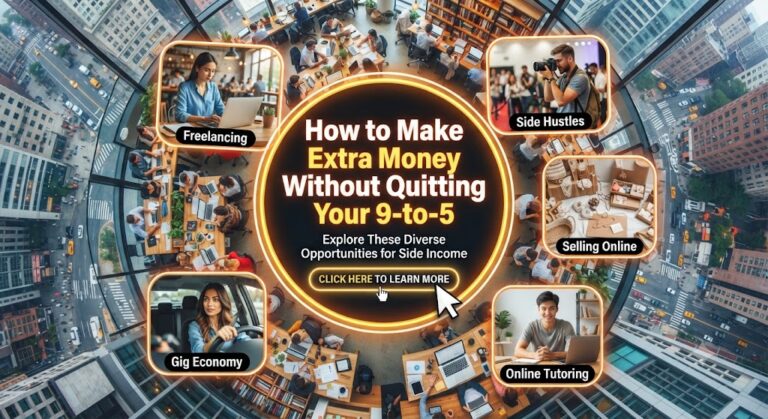
2. High-Leverage Side Hustles
Avoid “low-wage” side hustles like taking surveys. Focus on skills you already have.
- Freelancing: If you can write, code, design, or manage social media, use Upwork or Fiverr.
- Service-Based Labor: In a digital world, physical labor is at a premium. Pressure washing, car detailing, or pet sitting can earn you $30–$50 an hour on weekends.
- Tutoring: If you excelled in a particular subject or speak a second language, online tutoring platforms pay well and offer flexible hours.
3. Negotiate Your Salary
The fastest way to get $5,000 toward your goal is to ask for it at your current job. If you haven’t had a raise in over a year and your performance is high, schedule a meeting.
- The Script: “I’ve taken on [Project A] and [Project B], which resulted in [Result X]. Based on market data, I’d like to discuss adjusting my salary to [Number].”
- The “Save the Difference” Rule: If you get a raise, do not change your lifestyle. Send the entire post-tax difference directly to your $10k savings account.
Phase 5: Optimization and Automation
Now that you have money flowing in and expenses flowing out, you need to optimize the “plumbing” of your finances.
1. Automate the Transfer
Set up an automatic transfer from your checking account to your HYSA for the day after your paycheck hits. If you wait until the end of the month to “see what’s left,” there will be nothing left. You must pay yourself first.
2. Use “Round-Up” Tools
Apps like Acorns or many banking features allow you to round up every purchase to the nearest dollar and invest or save the difference. While this won’t get you to $10,000 on its own, it acts as “passive saving” that adds up to hundreds of dollars over a year.
3. The Cash-Only Challenge
If you find yourself overspending on “little things,” go to the ATM at the start of the week and withdraw your “fun money” in cash. When the cash is gone, the fun is over. It’s much harder to hand over a $20 bill than it is to tap a phone.
Phase 6: Overcoming the Mid-Way Slump
The first $2,000 is exciting. The last $1,000 is exhilarating. But the $4,000 to $7,000 range is where most people quit. This is the “Boring Middle.”
1. Gamify the Process
Create a visual tracker. Whether it’s a thermometer you color in or a spreadsheet that turns green, seeing progress visually triggers a dopamine response that keeps you going.
2. Celebrate Micro-Milestones
Don’t wait until $10,000 to celebrate. At $2,500, treat yourself to a nice dinner (within a budget). At $5,000, buy that book you’ve wanted. Acknowledging progress prevents burnout.
3. Surround Yourself with the Right Content
If you follow “flex culture” influencers who post about new cars and designer bags, you will feel deprived. If you follow personal finance creators, read books like The Simple Path to Wealth, or listen to podcasts about financial independence, you will feel motivated. Environment is stronger than willpower.
Phase 7: Avoiding the Pitfalls
As your balance grows, several traps will appear. Being aware of them is the only way to avoid them.
1. The “Lifestyle Creep” Trap
As you get closer to $10,000, you might feel “rich.” You might think, “I have $7,000 in the bank, I can afford to splurge on this vacation.” This is a trap. Lifestyle creep is the reason people who make $200k a year can still be broke. Keep your head down until the goal is met.
2. The “Emergency” That Isn’t
An emergency is a car breakdown or a medical bill. A “new iPhone release” or a “best friend’s bachelor party” is not an emergency. Learn to distinguish between the two. If you must use your savings for a genuine emergency, don’t beat yourself up. That’s what the money is there for. Just restart the process immediately.
3. The FOMO (Fear Of Missing Out)
Your friends will go to brunch. They will go on trips. They will buy new clothes. You will have to say “no” a lot. This is the “opportunity cost” of your first $10,000. Remember: you are trading a few months of temporary FOMO for a lifetime of financial security.
Phase 8: You Hit $10,000—Now What?
When that balance finally hits $10,000.00, take a breath. You have done what 60% of adults cannot do. You have built a fortress around your life.
But don’t stop there.
1. Protect It
Keep that $10k as your “Core Emergency Fund.” This money is not for investing in crypto; it’s not for a down payment. It is your “Sleep Better at Night” fund.
2. The Flywheel Effect
The skills you learned to save $10,000—budgeting, side hustling, discipline, and automation—are the exact same skills needed to save $100,000. The only difference is time and scale.
3. Start Investing
Now that your foundation is built, you can take your next $1,000 and put it into the stock market (Index Funds/ETFs). Now, instead of just you working for money, your money starts working for you.
Summary Checklist for Rapid Progress
To ensure you hit your goal faster than you think, follow this “Rapid Fire” checklist:
- Week 1: Open a High-Yield Savings Account at a new bank.
- Week 2: Audit your last 3 months of bank statements and cancel every subscription you don’t use daily.
- Week 3: Sell 5 items from your house on Facebook Marketplace.
- Week 4: Set up an automatic transfer for 15% of your paycheck (increase this as you cut costs).
- Month 2: Negotiate one major bill (Internet, Phone, or Insurance).
- Month 3: Start a side hustle that brings in at least $50 per week.
Saving your first $10,000 isn’t about luck. It isn’t about having a massive salary. It’s about intent. It’s about deciding that your future self deserves more than your current self’s temporary impulses.
The clock is ticking. Whether you start today or next year, the time will pass anyway. You might as well spend that time becoming a person with $10,000 in the bank.
Start now. Your future self is waiting.