
The AI Content Creation Business Blueprint
How to Build a Profitable Agency in 2026
Discover how to start an AI content creation business in 2026. This 3000+ word guide covers business models, SEO strategies, tools, and client acquisition.
Keywords: AI content creation business, AI content agency, generative AI marketing, AI SEO strategy, AI business ideas, content creation tools
Introduction: Why 2026 is the Year to Start an AI Content Business
Two years ago, starting a content agency meant raising capital or hiring a team of writers. In 2026, it means mastering AI tools and using them to solve a specific, measurable problem for clients .
The numbers tell the story. The AI content creation tool market is projected to grow from $1.25 billion in 2026 to $2.31 billion by 2030, a compound annual growth rate of 16.5% . Nearly three-quarters of marketers now use AI to create digital media, and over three-quarters of organizations say generative AI has improved the volume and speed of content production .
But here’s the crucial insight that separates successful AI content businesses from those that fail: the AI is the delivery mechanism, not the business itself. The business runs on client relationships, editorial judgment, and strategic thinking .
This comprehensive guide will walk you through everything you need to know to build a profitable AI content creation business in 2026.
1. Choosing Your AI Content Business Model
Before you start, you need to understand the three core business models dominating the AI economy in 2026 .
Service-Based AI Content Agency
Core Model: Offer AI-assisted content production, SEO optimization, and content strategy to clients.
Startup Cost: $0–$1,000
Revenue Model: Project fees, monthly retainers ($1,500–$5,000 per client)
Digital AI Products
Core Model: Sell prompt packs, templates, or AI-enhanced workflows.
Startup Cost: $0–$500
Revenue Model: One-time sales, subscriptions ($10–$100/month)
AI SaaS Platform
Core Model: Build a software product that solves a niche content problem.
Startup Cost: $5,000+
**Revenue Model:** Monthly subscriptions ($29–$199+/month)
For most entrepreneurs, the AI Content Agency model offers the fastest path to revenue and the lowest barrier to entry.
2. The Most Profitable AI Content Niches in 2026
AI Content Concierge Services
Companies need consistent content for blogs, newsletters, social media, and email. The challenge is developing a system that produces high-quality content at scale. This creates demand for AI-assisted content operations .
What You Can Offer:
- AI-assisted blog production aligned with SEO
- Editorial calendars and keyword clustering
- Lead nurturing email sequences
- Cross-platform content repurposing
- Performance tracking dashboards
Revenue Model: Charge $1,500 to $5,000 per client per month, with automation setup and reporting charged separately .
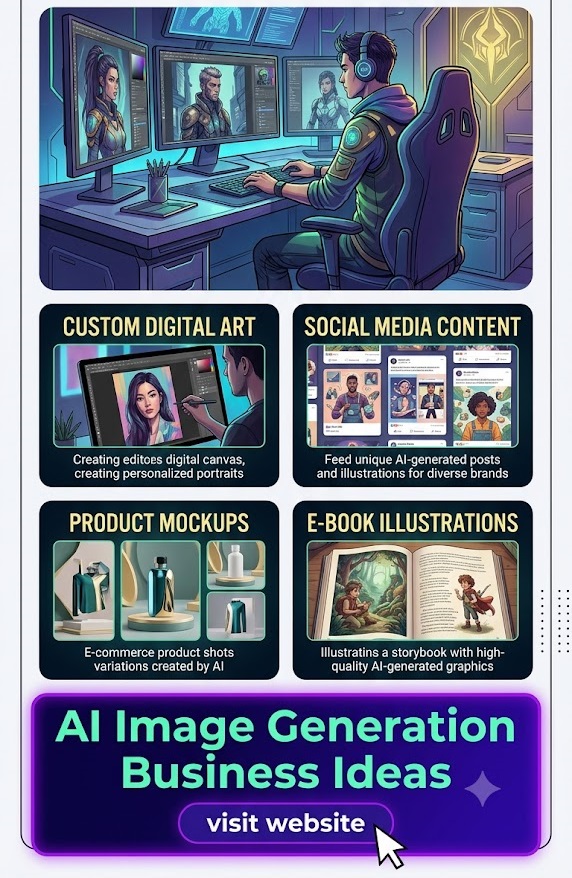
AI Art and Design Studio
Visual content drives engagement, yet producing high-quality graphics consistently challenges small businesses. According to HubSpot, nearly 75% of marketers use AI for digital media creation .
What You Can Offer:
- Logos and branding kits
- Book and product covers
- Ad graphics and social media visuals
- Print-on-demand merchandise designs
- Canva and Figma template packs
Revenue Model:
- Per design: $75–$300
- Package deals: $500–$2,500 for branding sets
- Print-on-demand products: $2–$15 per item
AI Video Editing and Production
Video content is in consistent demand across social media, marketing, and internal communications. AI-powered editing tools have dramatically reduced production costs .
What You Can Offer:
- Social media video content
- Marketing and promotional videos
- Internal training videos
- Short-form content for TikTok, Reels, and Shorts
Revenue Model: Per-project pricing or monthly retainers for clients with ongoing video needs .
AI Search / LLM Optimization Agency
As AI-powered search engines like ChatGPT, Perplexity, and Gemini become primary discovery channels, businesses need help optimizing their content for AI citation .
What You Can Offer:
- Content optimization for AI answer boxes
- GEO (Generative Engine Optimization) strategy
- FAQ and structured content development
- Brand monitoring in AI search results
3. Building Your AI Content Tech Stack
Essential AI Tools for Content Creation
| Category | Tools | Use Case |
|---|---|---|
| Copy & Brainstorming | ChatGPT, Claude, Jasper | Content ideas, outlines, first drafts |
| Image Generation | Midjourney, Leonardo AI, DALL-E | Visual content, branding assets |
| Video & Animation | Runway, Synthesia, VEED.IO | Video content, AI avatars |
| Audio & Voice | ElevenLabs, Murf AI | Voiceovers, narration |
| SEO Optimization | Surfer SEO, Frase, MarketMuse | Keyword research, content optimization |
| Design & Assembly | Canva, Adobe Firefly | Final polishing, templates |
The Key to Consistency: Training Your AI
The biggest hurdle in AI content creation is consistency. Brands need content that sounds and looks like them. You must develop processes for:
- Brand Voice Training: Use AI tools that allow custom fine-tuning on your client’s existing content.
- Visual Consistency: Train models on client brand assets to ensure visual output matches brand guidelines.
- Quality Control: Implement a “human-in-the-loop” editorial workflow .
4. The New SEO: Optimizing for AI Search Results
Traditional SEO is breaking down. Keyword tools rely on historical data that fails to capture live AI interactions .
Why Traditional Keywords Fail in AI Search
- Stale Data: Tools still rely on old Google queries.
- Flat Intent: They measure volume, not motivation or context.
- Single-Answer Logic: Legacy SEO assumes one query leads to one result. AI generates branching follow-up questions .
Prompt-Based Keyword Research
In 2026, understanding how customers talk to AI is more important than knowing what they type into Google .
Instead of targeting a generic phrase like “local marketing ideas,” uncover prompts such as:
- “How can I get more people to find my bakery on Google Maps?”
- “What’s the best way to collect emails from customers in-store?”
- “Write a short post to promote our new seasonal menu on Instagram.”
How to Find These Prompts:
- Observe AI Interfaces: Enter your seed topics into ChatGPT, Perplexity, or Gemini. Note how the AI autocompletes, what related questions it suggests, and which phrases appear most often .
- Map Conversation Flows: Prompts rarely stop at one question. Map how questions evolve. This shows you where people shift from research to action .
- Extract Entities and Themes: Highlight every tool, platform, or concept that repeats. Group these into clusters around shared goals. AI understands meaning through entities that appear together in context .
- Cross-Validate with Search Data: Use Ahrefs, Semrush, or Google Search Console to confirm there is real search demand for your prompt variations .
Structuring Content for AI Extraction
To get cited by AI systems, format your content for easy parsing :
What AI Search Engines Look For:
| Element | Why It Works |
|---|---|
| FAQs and Q&A | AI loves direct questions and answers |
| Listicles | Bullet points help AI scan and summarize |
| How-To Guides | Step-by-step formats match user intent |
| Data-Backed Content | Stats and expert quotes add credibility |
Scannable Structure Principles:
- Clear Hierarchical Headings: Use descriptive, question-based headers.
- Bullet Points and Lists: Much easier for AI to parse.
- Short Paragraphs: 2–4 sentences max. AI crawlers break content into chunks.
- Answer First, Explain Later: Lead with the direct answer before expanding .
Technical SEO for AI-Driven Search
AI search engines look beyond headlines. Backend cleanliness matters :
- Structured Data: Schema markup helps AI understand what your content means, not just what it says.
- Site Crawlability: Keep your sitemap updated and use internal links.
- Performance and Security: AI models prefer fast, secure websites.
5. The Human Element: Why Quality Beats Quantity
The biggest mistake in AI content creation is churning out AI slop. The market is getting crowded. Positioning around a specific vertical rather than general content is a stronger play than competing on price .
Why You Need a Human-in-the-Loop
Generative AI is already enabling marketing teams to push production to new heights. However, unconstrained generation introduces significant risks including factual hallucinations, duplicate content penalties, brand inconsistencies, and regulatory compliance issues .
The Editorial Workflow that Works:
- AI generates outline and draft
- Subject-matter expert reviews
- Fact-check with cited sources
- Legal/compliance sign-off
- Brand voice alignment check
Building Your Brand Guardrails
Create a living style guide that includes :
- Tone parameters
- Approved source list
- Escalation paths for sensitive topics
- AI content policy outlining acceptable use and review stages
6. Client Acquisition: How to Get Your First Paying Clients
You don’t need a massive portfolio to land your first client. Start by using your skills to create spec ads for existing brands .
- Pick a target business: Ideally a local business or e-commerce store.
- Create content using AI: Generate a high-end blog post, social media campaign, or video ad for one of their products.
- Post and tag: Share your work on social media and tag the brand.
- Pitch the outcome: Focus on business outcomes—more engagement, more saves, more sales—rather than just the cool factor of AI .
Pricing Models That Work
| Model | Description | Best For |
|---|---|---|
| Monthly Retainer | Fixed monthly fee for content volume | Ongoing content needs |
| Per-Project | One-off fee for specific deliverables | Campaigns, launches |
| Per-Asset | Per-post or per-piece pricing | Occasional clients |
| Outcome-Based | Performance-based pricing | SEO results, lead generation |
7. The Economics: How Much Can You Really Make?
The AI content creation business offers multiple revenue streams:
| Model | Revenue Potential |
|---|---|
| Freelance Creator | $500–$5,000/month per client |
| Content Agency Owner | $1,500–$5,000/month per client |
| Digital Product Seller | $10–$100 per prompt pack |
| Subscription Library | $20–$100/month per subscriber |
| AI Influencer Page | $10,000+/month from brand deals and subscriptions |
Case Study Example: A SaaS client might require 4 SEO blog posts, LinkedIn content, and automated email sequences monthly. Agencies can charge $1,500–$5,000 per client per month for this service .
8. Looking Ahead: Key 2026-2028 Trends
Agentic AI Will Reshape Operations
Agentic AI—systems that can operate autonomously—promises to go further than generative AI. As many as 69% of organizations expect agentic AI to assist employees with research, insights, or knowledge retrieval, and 59% foresee it managing internal workflows such as approvals, routing, and scheduling .
The Pricing Model Shift
By 2028, over 90% of vendors offering GenAI and agentic AI capabilities will lead with outcome- and consumption-based pricing models .
The Content Supply Chain Transformation
Over half of organizations describe their current content supply chain as linear and resource-intensive. Agentic AI is positioned to close this gap by introducing real-time, brand-compliant intelligence that orchestrates routing, approvals, scheduling, and asset reuse .
9. Common Pitfalls to Avoid
1. Over-Reliance on AI Without Quality Control
AI-generated content needs human oversight. Poor quality content can damage your brand’s credibility and lead to regulatory compliance issues.
2. Ignoring SEO Fundamentals for AI Search
AI search optimization doesn’t replace traditional SEO. You need both prompt-based keyword research and traditional keyword targeting.
3. Trying to Serve Every Industry
Success comes from specialization. Focus on a vertical where you have expertise—legal, healthcare, e-commerce, or SaaS.
4. Pricing Too Low
Clients equate low price with low quality. Position yourself as a premium service provider who delivers results.
5. Failing to Systemize Your Process
Without a repeatable system, scaling becomes impossible. Document your workflows and create templates.
10. Getting Started: Your 30-Day Launch Plan
Week 1: Foundation
- Choose your niche and business model
- Set up your tech stack (AI tools, CRM, project management)
- Define your service offerings and pricing
- Create a simple website/portfolio
Week 2: Product Creation
- Create sample content in your niche
- Develop your editorial workflow
- Set up quality control processes
- Create your first prompt pack or template
Week 3: Client Acquisition
- Create spec ads for target clients
- Post on social media and freelance platforms
- Start outreach to local businesses
- Build your network
Week 4: Systemization
- Document all your processes
- Set up client onboarding procedures
- Create service agreement templates
- Plan your growth strategy
Conclusion: Your AI Content Business Future
The opportunity in AI content creation is real and growing. By 2030, the market will exceed $2.3 billion . But success requires more than just knowing how to use AI tools.
What separates successful AI content business owners from the rest?
- They focus on quality over quantity. They don’t churn out AI slop.
- They understand SEO for the AI era. They optimize for both traditional search and AI-powered discovery.
- They have strong editorial judgment. They know when to trust the AI and when to override it.
- They systemize their processes. They can deliver consistent results at scale.
- They build real client relationships. The AI is the delivery mechanism; the business runs on trust.
“The AI is the delivery mechanism—the thing that makes the service faster, more scalable, or more affordable. But the business itself runs on client relationships.”
Start lean. Validate with a minimum viable offer. Get early feedback. Then scale what works.
The AI content creation business opportunity is here. Now it’s up to you to seize it.
Frequently Asked Questions
Is AI content creation profitable in 2026?
Yes. Businesses require ongoing content, creating recurring income opportunities for AI-powered content agencies. Freelancers earn $500–$5,000 per month per client, while agency owners can scale to multiple clients .
What skills do I need to start an AI content business?
Strong editorial judgment, knowledge of AI tools, understanding of SEO and prompt-based research, and the ability to manage quality control across multiple clients .
Can I start an AI content business with no budget?
Yes. Service-based AI businesses can be started with $0–$1,000 using free or freemium tools like ChatGPT, Canva, and social media for marketing .
Which AI tools are best for content creation?
Jasper, ChatGPT, and Claude for copy; Midjourney and Leonardo for images; Surfer SEO and Frase for optimization; Canva for assembly .
How do I get clients for my AI content agency?
Create spec ads for target brands, post on freelance platforms, network on LinkedIn, and leverage your existing contacts. Focus on results rather than technology