
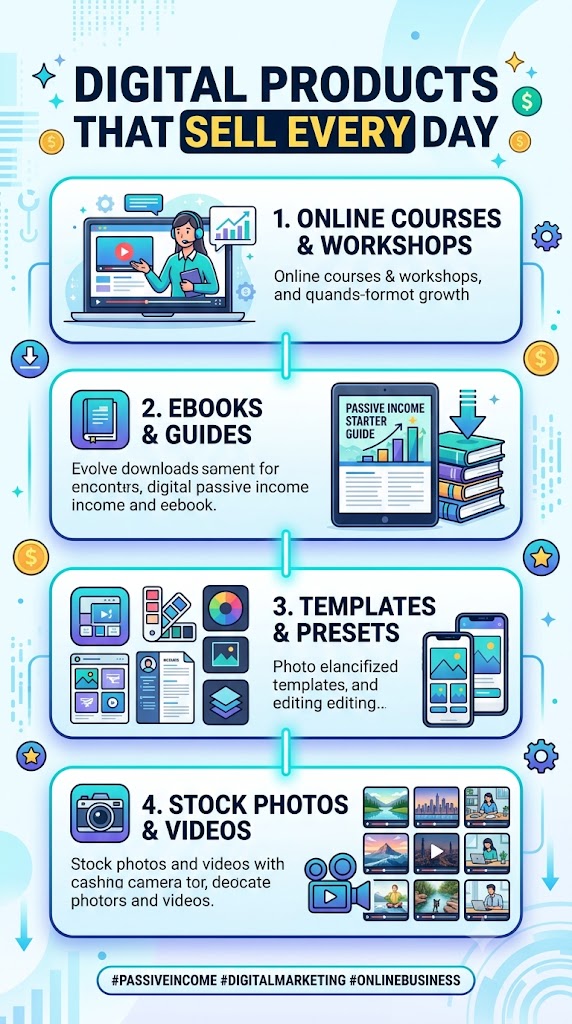
Digital Products That Sell Every Day
Your 2026 Guide to Consistent Passive Income
Picture this: you wake up, check your phone, and see three sales notifications from products you created months ago. You didn’t ship anything. You didn’t pack any boxes. You just… made money while you slept.
That’s not a fantasy. It’s the reality of selling digital products that have consistent, daily demand. In 2026, the digital product market is booming, with the interactive learning market alone projected to hit $23 billion . But here’s the thing—not every digital product sells every day. Some are seasonal cash grabs that fizzle out. Others? They’re the reliable workhorses that generate sales 24/7, 365 days a year.
So what actually sells every single day? Let’s break down the categories, the products, and exactly how to build a business that delivers consistent daily sales.
Why Some Digital Products Sell Daily (and Others Don’t)
Before we dive into the specific products, let’s understand what makes a product “evergreen” versus seasonal. Seasonal products like Halloween party games or Christmas planners are fun—they can give you a massive cash injection during the holidays. But once that event passes? Your sales disappear .
Evergreen products, on the other hand, solve problems people face every single day. They’re not tied to holidays or seasons. They’re the budget trackers, meal planners, and productivity templates that people need regardless of whether it’s January or July. One Etsy seller recently made 54 sales while on vacation—without even touching her laptop—because she focused on evergreen products .
The pattern across successful digital products is simple: people pay for anything that helps them make money, save money, get healthier, or solve an expensive problem . If your product does one of these things, someone somewhere needs it right now.
The 10 Digital Product Categories That Sell Every Day
1. Online Courses
Everyone says courses are dead, but that’s just not true. Based on data from over 100,000 sellers and $6 billion+ in sales, millions in course sales are still happening daily . People will always pay to learn faster .
Why they sell daily: Professionals upskilling, hobbyists exploring passions, and businesses training employees create constant demand .
Price range: $97-$497+
Pro tip: Don’t create a course about everything. Niche down. “Photoshop courses for real estate photographers” sells far better than “graphic design courses” .
2. Templates and Digital Planners
This is the ultimate low-effort, high-volume category. Notion templates, Canva kits, budget spreadsheets, digital planners—they’re in constant demand .
Why they sell daily: Every business, student, and creator needs organization tools. Students search for study planners every year. Entrepreneurs need social media planners and content calendars year-round .
Price range: $15-$97
Top sellers:
- Notion dashboards
- Budget trackers
- Daily planners and habit trackers
- Social media content calendars
- Invoice and proposal templates
Pro tip: Treat these like a product line rather than one-off creations. The best sellers create bundles and collections .
3. eBooks and Cheat Sheets
A PDF can be anything—an ebook, a cheat sheet, a checklist. The price point removes all friction, making it the easiest front-end offer to build .
Why they sell daily: Low price point triggers impulse purchases. Niche topics attract specific audiences actively searching for solutions .
Price range: $15-$47
What works: Finance, productivity, marketing, wellness, and entrepreneurship topics consistently perform well . Niche-specific always beats broad topics .
Pro tip: Use these as front-end offers to build your email list. Then upsell to courses or memberships .
4. Mini Software Apps and Tools
Here’s where AI has changed the game. You don’t need to be an engineer to build a simple tool, quiz, or Chrome extension anymore. The barrier to entry is gone .
Why they sell daily: Tools solve specific problems instantly. Businesses need calculators, generators, and automation tools constantly .
Price range: $27-$197
What’s hot:
- AI prompt packs
- ROI and profit margin calculators
- Quiz builders
- Chrome extensions
- Business name generators
5. Memberships and Communities
This model creates recurring revenue, but it’s also the hardest to sustain. Churn is brutal, so if you’re going to do this, charge annually .
Why they sell daily: People want ongoing access to exclusive content, resources, and community support .
Price range: $27-$97/month
What works: Business resource libraries, stock photo memberships, and coaching vaults .
Pro tip: Don’t start with a membership. Build a front-end product first, then a mid-tier course, and only then consider a membership for your most committed buyers .
6. Digital Marketing Toolkits
Small business owners pay for anything that saves time on marketing. Email swipe files, ad libraries, and funnel templates are in constant demand .
Why they sell daily: Business owners are always looking for shortcuts and proven systems. They don’t have time to reinvent the wheel.
Price range: $27-$147
What works:
7. Social Media Templates
Every brand needs consistent visuals, and most don’t have a designer. Canva-compatible templates are in constant demand .
Why they sell daily: Creators and small businesses need fresh content constantly. Templates let them maintain consistency without the design skill.
Price range: $15-$47 per pack
What works: Instagram templates, Pinterest pins, LinkedIn carousel templates, and brand style guides .
8. Website Themes and Landing Page Templates
Clean, high-converting layouts for Shopify, WordPress, and landing page builders sell every day .
Why they sell daily: Millions of websites launch daily. Most site owners lack design or coding skills .
Price range: $47-$197
What works: Shopify themes, WordPress themes, landing page templates for platforms like SamCart and ClickFunnels .
Pro tip: Provide updates and support to build a loyal customer base .
9. Health and Fitness Guides
This niche never slows down. People always want to get healthier, and a well-packaged meal plan or fitness guide at $27-$97 is one of the easiest digital products to sell .
Why they sell daily: Health is an evergreen concern. It’s January? New Year’s resolutions. It’s June? Beach body season. It’s October? Holiday prevention.
What works: Meal plans, fitness trackers, workout guides, and wellness journals .
Pro tip: Bundle a 30-day challenge with a meal plan and fitness tracker for a higher-priced offering.
10. Personal Finance Spreadsheets
People need help managing money. They don’t trust institutions, and they want to figure it out themselves. Budgeting tools in Google Sheets are one of the most searched digital products right now .
Why they sell daily: Financial stress is constant. People are always looking for tools to manage their money better.
Price range: $17-$47
What works: Budget trackers, savings challenges, expense trackers, and debt payoff planners .
The “Too Easy” Products That Quietly Generate Daily Sales
Some digital products look almost “too simple” to be profitable. That’s exactly why most people ignore them. In 2026, these simple utility-based products continue to generate steady, reliable income :
AI Utility Products:
- AI email reply templates
- AI resume improvement bullets
- AI caption swipe files
- AI content idea lists
- AI productivity prompt packs
Business Essentials:
- Contract templates
- Proposal templates
- Client onboarding checklists
- Price list sheets
Everyday Life Utilities:
- Budget trackers
- Savings challenges
- Meal planners
- Travel checklists
- Self-care journals
- Mood trackers
These solve simple but constant daily problems. And because they’re simple to create, you can build a catalog of them quickly .
The App Economy: A Different Kind of Daily Seller
While not a “digital download” in the traditional sense, mobile apps represent a massive opportunity for daily sales. In 2025, certain app niches demonstrated consistent revenue performance :
Top-performing categories:
- Finance tools (currency converters, budgeting tools, loan calculators)
- Educational apps (language learning, quiz platforms)
- Productivity utilities (document scanners, reminders, cleaning utilities)
- Health and fitness trackers
These categories attract large user bases and maintain advertiser interest across multiple markets . ChatGPT alone dominated European downloads with over 64 million installs in 2025 .
Revenue models: Upfront purchase, in-app purchases, subscriptions, and advertising .
How to Price Your Digital Products
Pricing directly impacts whether your products sell daily. Here’s a three-tier strategy that works:
Front-End Offer ($17-$47): Your ebook, template, or cheat sheet. Low friction, high volume, removes risk for the buyer .
Mid-Tier Offer ($97-$297): Your course, template bundle, or toolkit. Serves people ready to go deeper .
Back-End Offer ($297+): Your membership, advanced toolkit, or coaching program. Captures recurring revenue from your most committed buyers .
Most creators skip straight to the middle or top layer and wonder why they’re not selling .
Building Your Digital Product Business: A Step-by-Step Plan
Step 1: Audit Your Expertise
What do you already know that people pay to learn? Not what you think is valuable, but what solves a problem someone’s actively searching for or spending money on right now .
Step 2: Validate Your Idea
Before you create anything, validate the market demand. Use keyword tools, analyze competitors, and engage in online communities to identify real problems people are trying to solve .
Step 3: Create an MVP (Minimum Viable Product)
Start with the core offering. You can always add more modules, features, or bonus content later based on customer feedback .
Step 4: Set Up Your Tech Stack
Choose a platform for hosting, a secure payment gateway, and an email marketing service. Avoid software bloat—especially if you’re just starting with a $15-$20 ebook .
Step 5: Market Relentlessly
Creation is only half the battle. Build an audience through content marketing, social media, and SEO. Your launch should be an event, not a quiet upload .
Step 6: Iterate Based on Feedback
Digital products can be updated easily. Keep improving based on customer feedback and trends .
Common Mistakes to Avoid
Mistake 1: Chasing Trends Instead of Evergreen
Seasonal products give you peaks and valleys. Evergreen products give you consistency. Build your foundation on evergreen .
Mistake 2: Overcomplicating the Product
“Too easy” products often sell best because they solve simple, recurring problems. Don’t overcomplicate the design .
Mistake 3: Skipping the Front-End Offer
Starting with a high-ticket course or membership before you have a front-end product rarely works. Build trust with low-friction offers first .
Mistake 4: Ignoring Customer Feedback
The best sellers iterate based on feedback. Listen to what your customers actually want .
The Bottom Line
The digital products that sell every day share a common thread: they solve a problem people face constantly. Whether it’s organizing their finances, learning a new skill, saving time on marketing, or getting healthier, the demand is always there.
The best part? Once created, these products can be sold repeatedly with little to no extra cost . They can generate revenue while you sleep, while you’re on vacation, or while you’re building your next product .
The opportunity is real. The tools are accessible. And your audience is already out there searching for the solution you can provide .
Start small. Focus on evergreen. Build a product line, not just a single product. And most importantly—start today.
As one creator put it: “Stop overthinking. Start building today