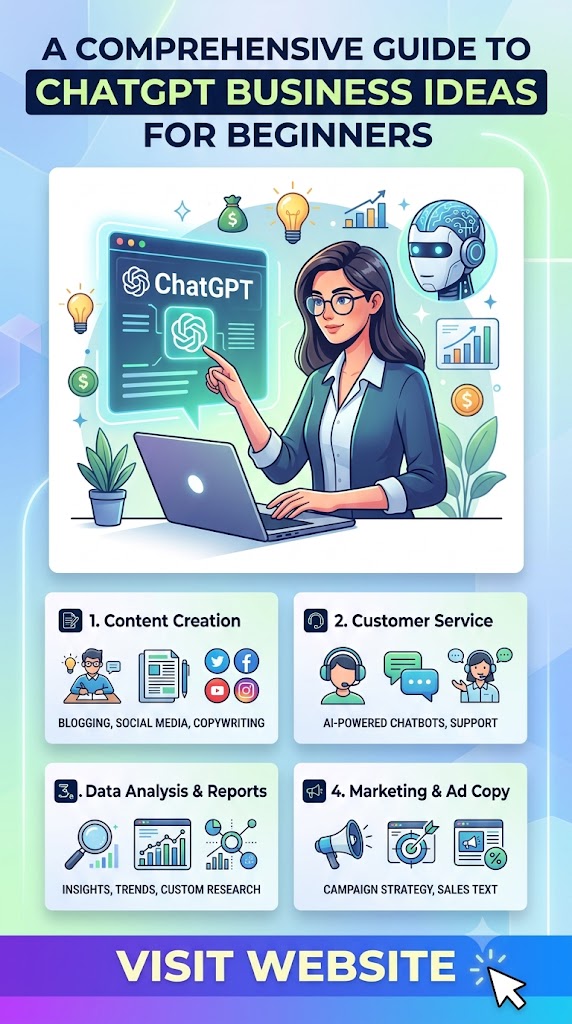
A Comprehensive Guide to ChatGPT Business Ideas for Beginners
Leveraging AI for Entrepreneurial Success
The emergence of Large Language Models (LLMs), spearheaded by OpenAI’s ChatGPT, has fundamentally altered the landscape of modern entrepreneurship. For the first time in history, the barrier to entry for complex, knowledge-based businesses has been significantly lowered. Beginners who previously lacked specialized skills in coding, high-level copywriting, or data analysis can now leverage artificial intelligence to compete with established agencies.
However, the key to success lies not in the tool itself, but in how one applies it to solve specific market problems. This guide explores a diverse array of ChatGPT-centric business ideas, ranging from content services to technical consulting, designed specifically for those starting their entrepreneurial journey.
1. Content Creation and Digital Storytelling Agency
Content remains the cornerstone of the digital economy. Businesses require a constant stream of high-quality material to maintain visibility, yet many lack the time or resources to produce it consistently.
Blog and Article Writing Services
While many fear that AI will replace writers, the reality is that it has created a demand for “AI-augmented” editors. You can start a service that provides high-volume, SEO-optimized blog posts.
- The Strategy: Use ChatGPT to generate outlines and initial drafts based on specific keywords.
- The Value Add: Your role is to provide the “human touch”—fact-checking, adding personal anecdotes, and ensuring the brand voice is consistent.
- Monetization: Charge per word or offer monthly subscription packages for a set number of articles.
Social Media Management and Scripting
Maintaining an active presence across LinkedIn, X (Twitter), Instagram, and TikTok is exhausting for small business owners.
- Caption Generation: Create months’ worth of social media captions in minutes.
- Video Scripting: Use ChatGPT to write scripts for YouTube Shorts or Reels, focusing on high-retention hooks and clear calls to action.
- Content Repurposing: Take a single long-form video or podcast and use ChatGPT to turn it into ten tweets, two LinkedIn posts, and a newsletter.
2. Specialized SEO and Marketing Services
Search Engine Optimization (SEO) is often perceived as a “black box” by beginners, but ChatGPT simplifies the technical and creative aspects of the field.
SEO Metadata and Description Optimization
E-commerce stores with thousands of products often have poor SEO because writing unique descriptions for every item is tedious.
- The Service: Use ChatGPT to generate unique, keyword-rich product descriptions and meta titles/descriptions.
- Scaling: By using the ChatGPT API or bulk processing prompts, you can optimize an entire online store in a fraction of the time it would take a manual copywriter.
Email Marketing and Lead Nurturing
Email marketing boasts one of the highest ROIs in digital marketing.
- Cold Outreach: Generate personalized cold email templates for B2B companies.
- Newsletter Curation: Use ChatGPT to summarize industry news and turn it into a weekly digest for a specific niche (e.g., “The Weekly Real Estate Report”).
- Autoresponder Sequences: Build “welcome series” for brands to help them convert new subscribers into customers.
3. The Prompt Engineering Consultancy
As more businesses attempt to integrate AI, they often find that “garbage in equals garbage out.” Many professionals struggle to get the desired results from ChatGPT because they do not know how to phrase their queries.
Custom Prompt Library Development
You can build and sell specialized “Prompt Kits” for specific industries.
- Target Markets: Real estate agents, lawyers, fitness coaches, or teachers.
- Product: A PDF or Notion database containing 50–100 deeply engineered prompts that help these professionals automate their specific daily tasks.
Corporate AI Training
Many traditional companies are eager to adopt AI but are afraid of data privacy issues or simple incompetence.
- The Service: Offer “Introduction to AI” workshops. Teach teams how to use ChatGPT for internal documentation, meeting summaries, and brainstorming.
- Niche Positioning: Position yourself as an “AI Implementation Consultant” rather than just a ChatGPT user.
4. Digital Product Creation and Education
The “knowledge economy” is perfectly suited for AI-assisted workflows. You can create products once and sell them indefinitely.
E-Book Publishing and Lead Magnets
Self-publishing has never been more accessible.
- How to Start: Identify a “pain point” in a niche (e.g., “How to Start a Garden for Beginners”). Use ChatGPT to structure the chapters, generate the content, and even suggest titles.
- Refinement: Use tools like Canva to format the book and Amazon KDP to publish it.
- Lead Magnets: Create short PDF guides that businesses can give away in exchange for email sign-ups.
Online Course Curriculum Design
Educators and influencers often have the knowledge but struggle to structure it into a logical course.
- The Service: Take a client’s raw notes or transcripts and use ChatGPT to create a comprehensive syllabus, lesson plans, quizzes, and slide deck scripts.
5. Technical and Operational Support
Even if you aren’t a software engineer, ChatGPT’s ability to interpret and generate code allows you to offer technical services that were previously out of reach.
No-Code and Low-Code Development
Many businesses need simple automation but cannot afford a full-time developer.
- The Solution: Use ChatGPT to write custom scripts for Google Sheets (Google Apps Script) or to set up complex “Zaps” in Zapier.
- Example: Create a system where a customer inquiry on a website automatically generates a personalized response via ChatGPT and logs the data in a CRM.
AI Chatbot Implementation
Small businesses (dentists, plumbers, local boutiques) often miss leads because they don’t respond to website inquiries quickly enough.
- The Service: Use platforms like Chatbase or TypingMind to build “Custom GPTs” trained on a company’s specific data (FAQs, pricing, services).
- Value: These bots can handle 80% of customer queries 24/7, acting as a virtual receptionist.
6. Strategic Advice for AI Beginners
Launching an AI-based business requires a blend of technological proficiency and traditional business acumen.
Focus on Problem-Solving, Not the Tool
Do not sell “ChatGPT services.” Sell “Increased Lead Generation,” “Reduced Operational Costs,” or “Faster Content Turnaround.” Clients care about results, not the software you use to achieve them.
The Importance of Human Oversight
AI is prone to “hallucinations” (generating false information). To build a sustainable business, you must act as the ultimate editor. Never deliver AI-generated content without a thorough review for:
- Accuracy: Verify all facts, dates, and citations.
- Brand Voice: Ensure the tone isn’t overly robotic or generic.
- Plagiarism: While ChatGPT generates original text, it is good practice to run high-stakes content through plagiarism checkers.
Pricing Your Services
Since AI allows you to work faster, avoid hourly billing whenever possible. If a project used to take 10 hours but now takes you 2 hours with ChatGPT, billing hourly penalizes your efficiency. Instead:
- Value-Based Pricing: Charge based on the value the client receives.
- Package Pricing: Offer flat fees for specific deliverables (e.g., $500 for a 5-email sequence).
Conclusion: Taking the First Step
The window of opportunity for AI-driven businesses is wide open, but it will not stay this way forever as the market becomes more saturated. For a beginner, the best approach is to pick one niche—whether it is SEO, social media management, or chatbot implementation—and master the specific prompts and workflows required to deliver excellence in that area.
By combining the raw processing power of ChatGPT with human creativity and strategic thinking, you can build a scalable, modern business that thrives in the age of artificial intelligence. The key is to start small, iterate quickly, and always prioritize the needs of the client over the novelty of the technology.